Analysing Substructures#
When analyzing large structures, but you’re really only interested in small parts of the whole, it might be more useful to instead resort to a partial analysis.
We will use the biphenyl molecule to illustrate a partial analysis. To start, there are two approaches to be considered:
You performed a frequency analysis on the entire structure, or
you did so only on parts of the molecule to save computational resources
Full Hessian#
Assuming you performed a frequency analysis on the entire structure, but are only interested in parts thereof, you should pick this approach.
from strainjedi.jedi import Jedi
from strainjedi.io import read_output
from strainjedi.io.adapter import to_atoms, to_vibrations

mol = to_atoms(read_output("opt/OUTCAR"))
mol2 = to_atoms(read_output("dist/OUTCAR"))
hessian = to_vibrations(read_output("freq/OUTCAR"), mol)

jedi = Jedi(mol, mol2, hessian)
jedi.run()
jedi.visualize(show=True, show_indices=True)
Running this script opens our trusted visualization window as shown below.
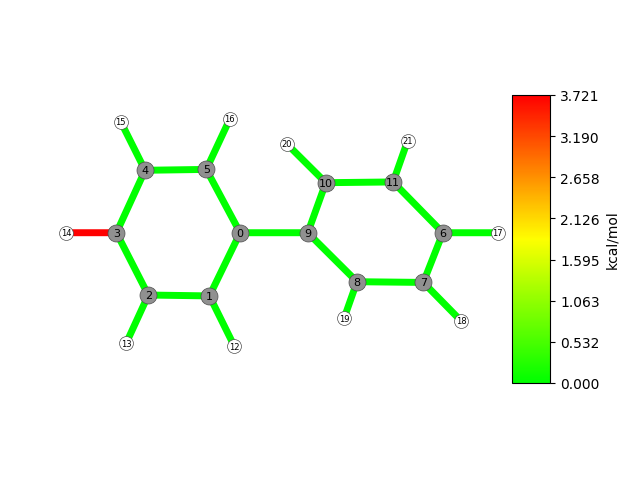
As all bonds are colored, you can see that JEDI still analyzed the entire structure. Let’s fix that by providing the indices we are actually interested in, which is the benzene ring with the strained C-H bond. From the image, it’s clear that the atoms with the indices 6 to 11, and 17 to 21 do not (significantly) contribute to the strain, so we will ignore those.
Therefore will modify the run() call as following, keeping in mind to provide the indices we are interested in (as opposed to the ones we do not care about).
jedi.run(indices=[0, 1, 2, 3, 4, 5, 12, 13, 14, 15, 16])
And execute the script again.
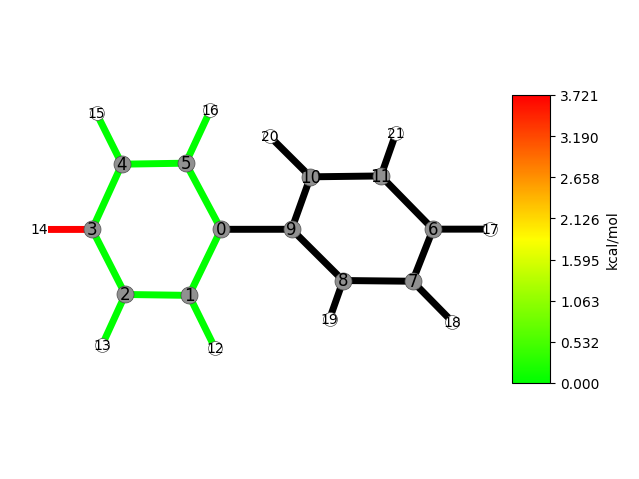
The unanalyzed part of the structure is now indicated by black bonds.
Partial Hessian#
JEDI also supports the result of a partial frequency analysis, though such an analysis may not be started by calling run() on your Jedi object.
Instead, we must explicitly call partial_analysis(), with indices similar to how we performed an analysis with the full Hessian.
Furthermore, also the to_vibrations() function needs the atom indices to extract the partial hessian.
from strainjedi.jedi import Jedi
from strainjedi.io import read_output
from strainjedi.io.adapter import to_atoms, to_vibrations

mol = to_atoms(read_output("opt/OUTCAR"))
mol2 = to_atoms(read_output("dist/OUTCAR"))
substructure = [0,1,2,3,4,5,12,13,14,15,16]
part_hessian = to_vibrations(read_output("p-freq/OUTCAR"), mol, indices=substructure)

jedi = Jedi(mol, mol2, part_hessian)
jedi.partial_analysis(indices=substructure)
jedi.visualize(show=True, show_indices=True)
Conclusion#
To summarise on which approach to pick: if you have a full frequency analysis, call run() as the “normal” entry point.
In case of a partial frequency analysis, use partial_analysis().
Either Jedi functions expect indices of the atoms you are interested in.
Downloads#
To follow along in these examples, feel free to download the archive listed below. The calculations were performed using the VASP calculator.